Know Exactly Who Enters, and When: Access Control Systems in Norwalk, CT
Every business decides, every day, who gets through its doors. A traditional lock and a ring of keys make that decision poorly: keys get copied, lost, and kept by former employees, and a lock tells no one who came and went. Access control replaces that guesswork with a system that grants entry by credential and logs every use. Mammoth Security Inc. designs and installs commercial access control systems across Norwalk, with a local office at 48 Westport Avenue serving the city and the surrounding Fairfield County coast.
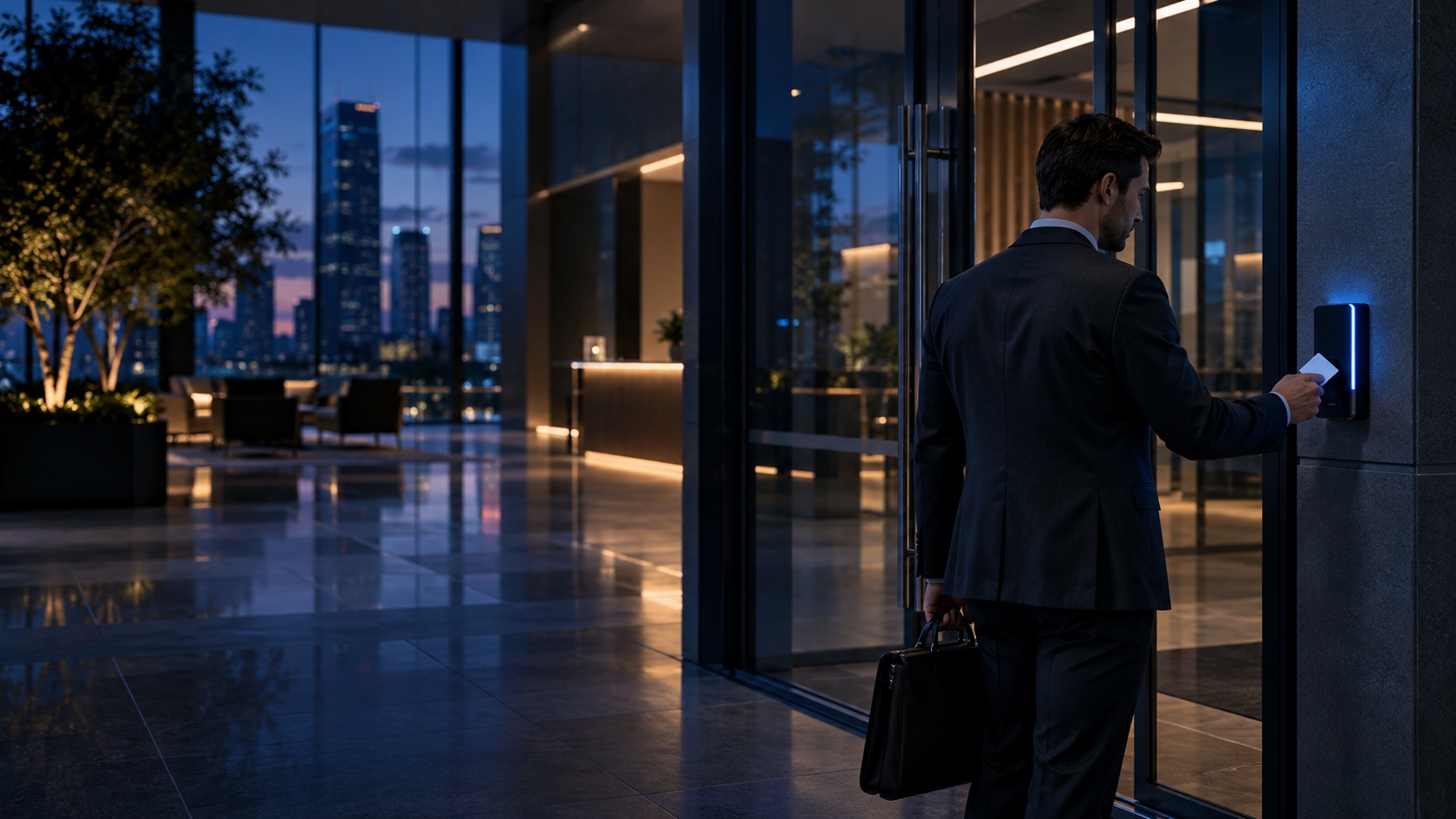
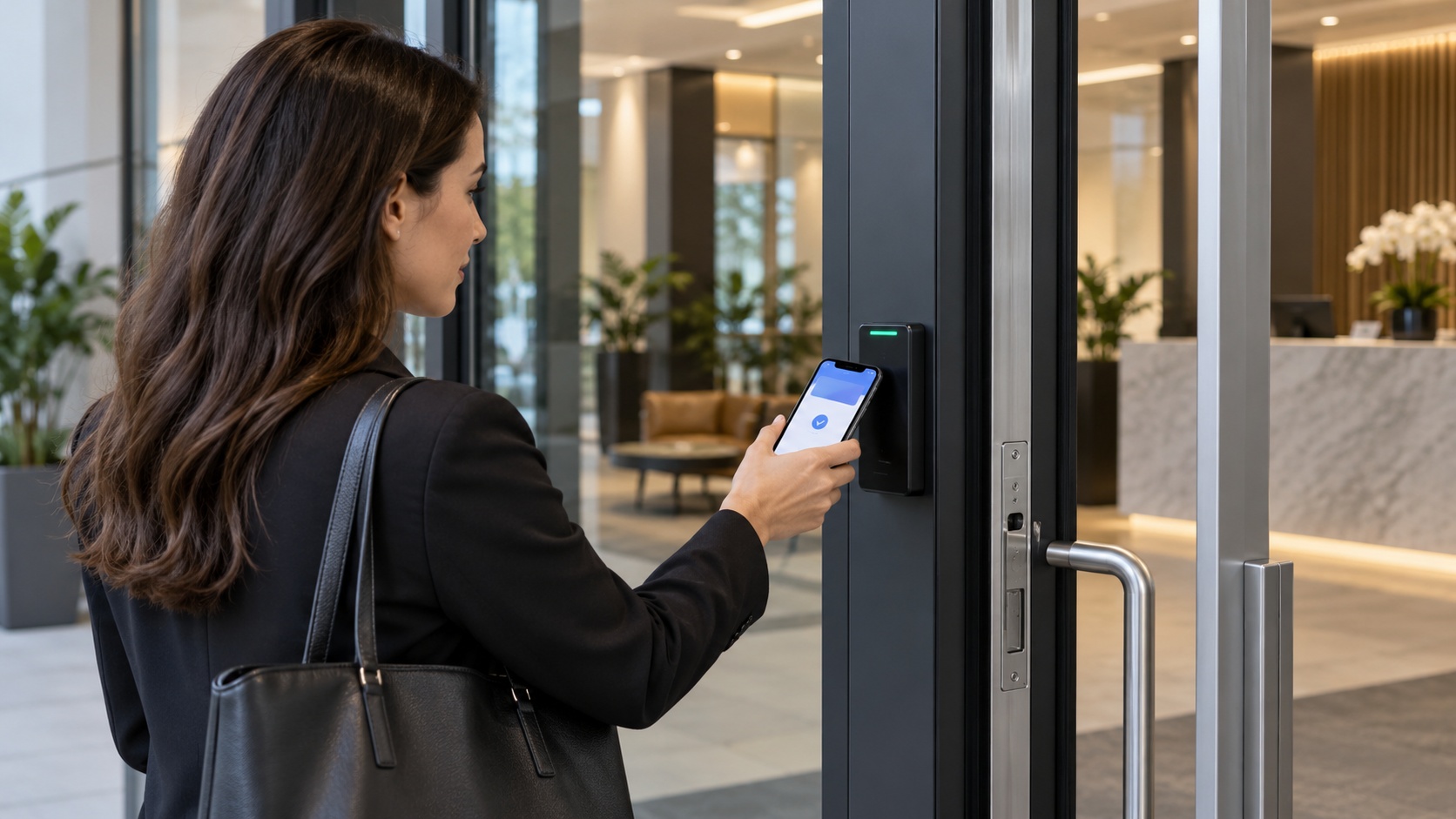
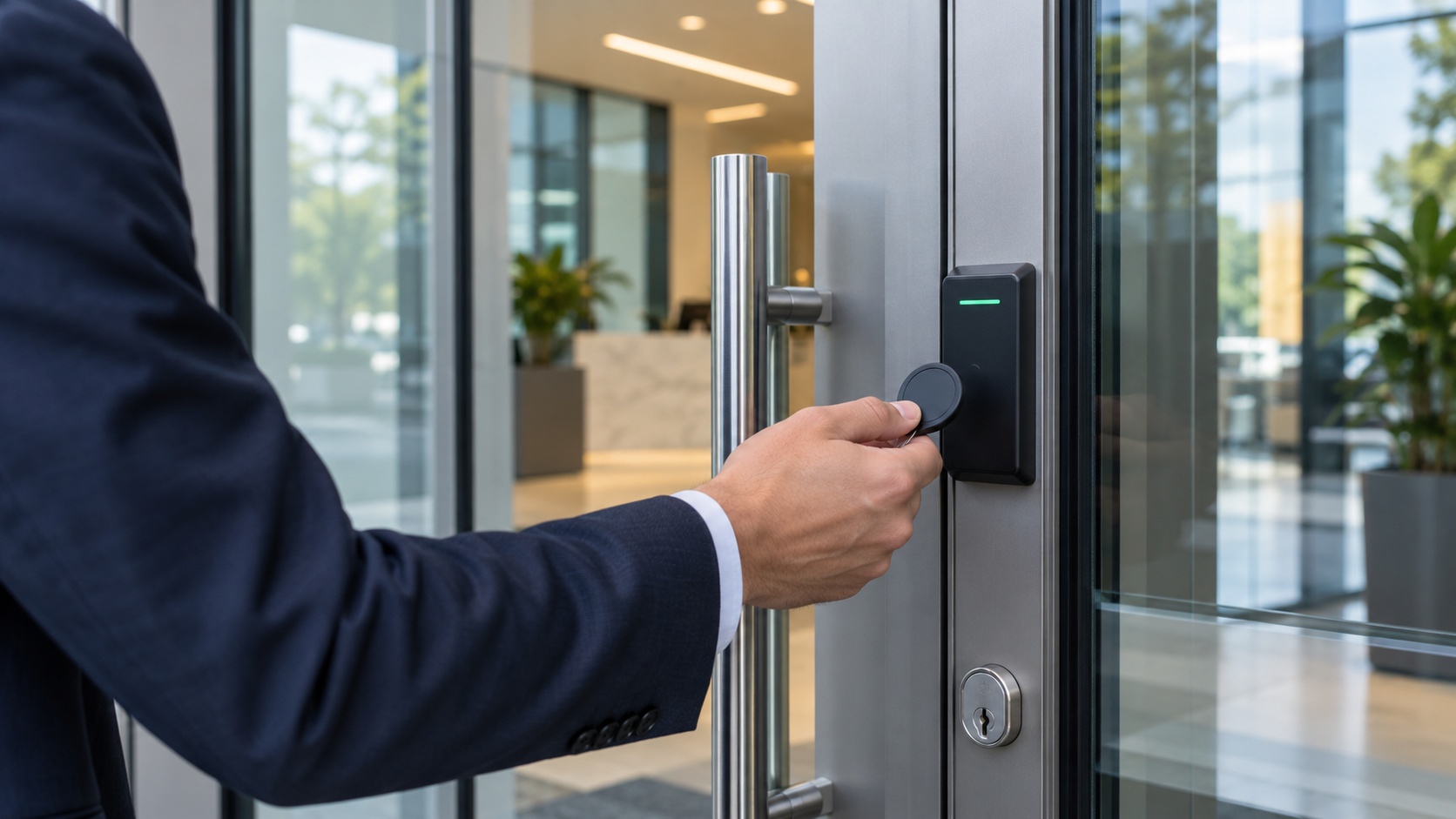
Access control is a system that requires a valid electronic credential, a key fob, a smart card, a mobile credential on a phone, or a PIN code, before an electrified door will open. Behind the door, a controller checks the credential against a database of permissions and unlocks only for those authorized, at the times they are allowed. That simple change solves the two problems a key never could: it controls access precisely, and it records it completely.
Why Credentials Beat Keys
The advantage of a credential over a key is control that can change in an instant. When an employee leaves a Norwalk business, a manager deactivates the credential in seconds, and the former worker cannot enter again, no locksmith, no rekeying, no lingering risk that a copied key is still out there. New employees get a credential the moment they start. A lost fob is deactivated and replaced without touching the locks. For a business with turnover, that control alone justifies the system, because every key-based building carries the quiet risk of keys held by people who no longer belong there.
The second advantage is the record. Every credentialed entry is logged with a time stamp, so a Norwalk business knows who entered which door and when. That audit trail matters when inventory shrinks, when an incident occurs after hours, or when a dispute turns on who was present. Time-based permissions add another layer, limiting a credential to certain hours so a cleaning crew's access works in the evening and not at midnight, or a contractor's works during the project and expires when it ends. Mammoth Security programs these permissions to how a Norwalk business actually runs.
A Departed Employee Is Locked Out Instantly
With access control, a Norwalk manager deactivates a former employee's credential in seconds, closing the security gap that a key-based building leaves open until every lock is rekeyed and every copied key is accounted for.
The Log Answers 'Who and When'
Every credentialed entry is time-stamped, so an access system produces the record that narrows a question when inventory shrinks, an after-hours incident occurs, or a dispute turns on who was present.
A Failed Door Is an Emergency
A controller failure or a dead reader can leave a business unable to secure its building or locked out of it, which is why access control repair is a standing, responsive service rather than a routine appointment.
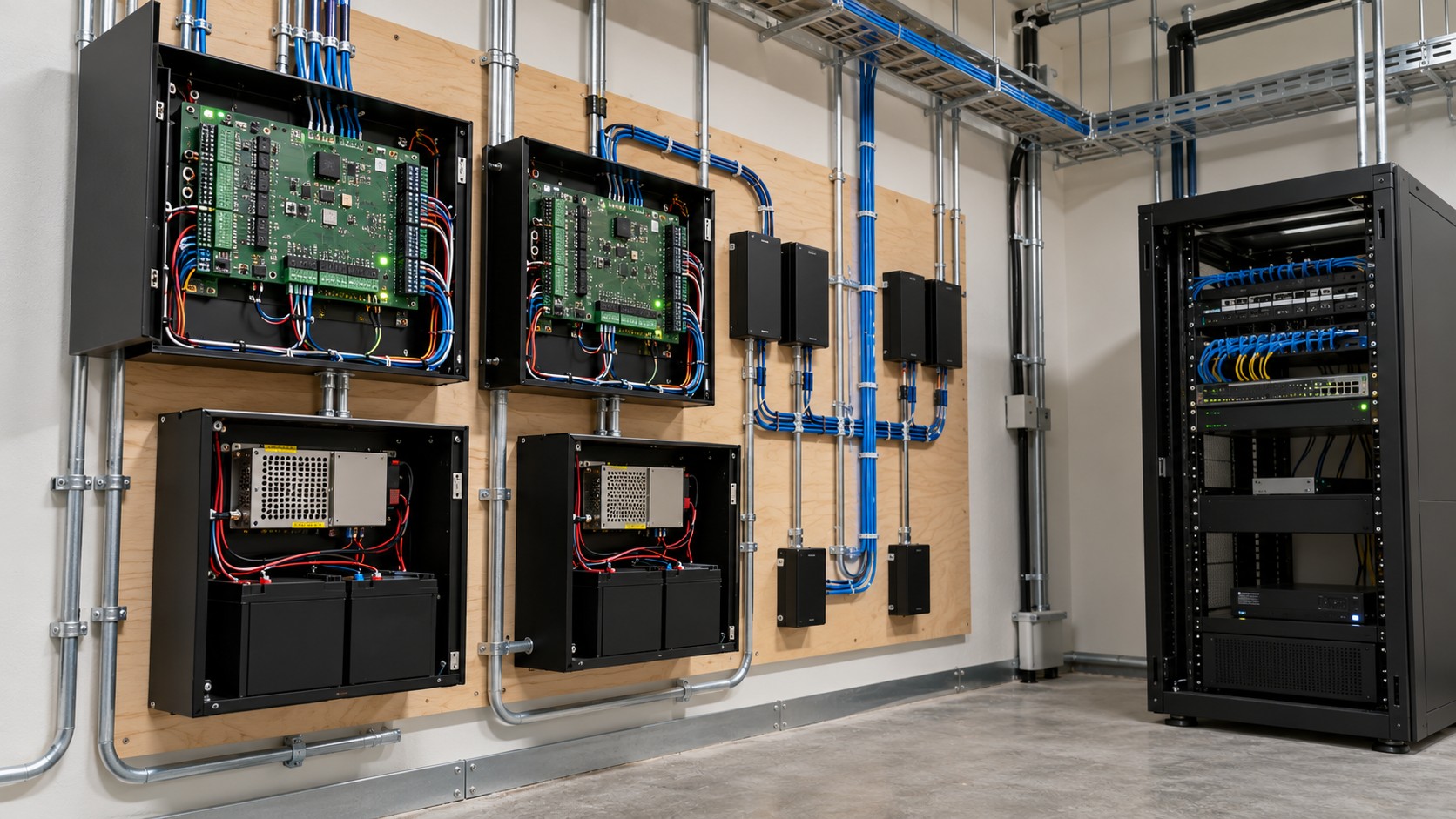
Access control is built from controllers, credential readers, and electrified door hardware. Controllers can be cloud-managed, letting a manager administer access from anywhere through a web dashboard, or on-premises, keeping the system self-contained on site, and the right choice depends on how a Norwalk business wants to run it. Credential technology ranges from proximity and smart cards to mobile credentials that turn a phone into a key to biometric readers that confirm identity by fingerprint or face for higher-security doors. Electrified hardware, an electric strike, a magnetic lock, or electrified lockset, does the physical locking, matched to the door and the fire-egress requirements. Mammoth Security works with premium and trusted access brands including DMP, Avigilon, ICT, and Brivo, chosen for reliability and for how well they integrate with a building's cameras and alarms.
Integration is where access control becomes more than a lock. Tied to the camera system, a door event pulls up the video of it, so a Norwalk security team sees who badged through a door and watches the clip together, turning an access log into visual proof. Tied to the alarm and monitoring, a forced door or an access violation triggers an alert. A door held open too long, a credential used where it should not be, an attempt on a restricted door, each becomes a notification rather than an unnoticed event. That integration is the payoff of using one integrator for the whole system.
Access Control Repair When a Door Fails
A door that will not lock is an emergency, and a door that will not unlock can be worse. When a controller fails, a card reader dies, a maglock stops holding, or door hardware breaks, a Norwalk business can be unable to secure its building or locked out of it, and that cannot wait for a routine appointment. Mammoth Security provides access control repair as a standing service, diagnosing and fixing failed controllers, readers, locks, and door hardware to get a door working again. For many Norwalk businesses, a repair is the first contact with Mammoth Security, and it often becomes the start of a longer relationship, because a business that sees the problem fixed right brings the rest of its security to the same team. For existing clients, repair and service are always part of the commitment.
Local Service, Statewide Backing
Access control is a system a business lives with daily, which makes local, responsive service matter. A credential set changes as staff turns over, permissions get adjusted, and hardware occasionally needs attention, and a Norwalk business is better served by a local team than a distant call center. Mammoth Security serves Norwalk from its Westport Avenue office with in-house W-2 technicians, not subcontractors, backed by a statewide Connecticut company with four locations, including New Britain, and more than 5,000 buildings secured. The same team that designs a system programs it, services it, and answers when a door needs attention.
Access Control Across Norwalk's Businesses
The value of access control shifts with the business. A professional office, a law firm or medical practice, uses it to secure records, protect after-hours access, and log who reached sensitive areas, which in a medical setting supports the documentation compliance requires. A retail store or restaurant controls back-of-house doors to offices, storage, and cash-handling areas, limiting who reaches inventory and money. An industrial facility controls gates, docks, and restricted production areas, tracking contractors and staff across a large site. A multi-family community, Mammoth Security's most-served type, controls entrances, amenities, and parking for a resident population that turns over. In each case the same core system is programmed to a different set of doors, permissions, and schedules, which is why an integrator that understands the business designs a better system than one applying a generic template.
Egress, Fire Safety, and Code
An access control system controls entry, but it can never trap people inside, and code makes that non-negotiable. A controlled door needs a request-to-exit device, the motion sensor mounted above a controlled door that detects a person leaving and unlocks the door for egress without triggering an alarm, and the electrified hardware has to release on a fire alarm so occupants can evacuate freely. Magnetic locks in particular must be tied to the fire system so an alarm drops them. A properly designed Norwalk access system secures a building against unauthorized entry while guaranteeing free exit in an emergency, and getting that balance right is exactly the kind of detail that separates a professional integrator from a general contractor mounting a lock. Mammoth Security designs access control to secure the building and satisfy the fire-egress and building-code requirements together.
Cloud Management for Multi-Site Businesses
A Norwalk business with more than one location, or a management company with several properties, gains a specific advantage from cloud-managed access control. A cloud controller lets an administrator manage every door across every site from one web dashboard, granting and revoking credentials, adjusting permissions, and pulling entry logs without visiting each building. A regional manager cuts off a departed employee at all locations at once, or grants a contractor timed access to a single site from a phone. That central control turns a scattered set of buildings into one managed system, and it is part of why a growing Norwalk business benefits from an integrator that can design for scale rather than one door at a time.
The Norwalk businesses that control access best are the ones that treat it as part of an integrated system, tied to cameras and alarms, designed around the building's real doors and schedules, and serviced by a local team that responds when a credential changes or a door fails. Designed that way, access control stops being a set of locks and becomes a managed, recorded, code-compliant system that a business can actually run. That is the standard Mammoth Security brings to Norwalk from its Westport Avenue office, whether a business needs a new system installed or a failed one repaired.
Access control is a daily system, touched every time someone enters, so responsive local service is part of what a Norwalk business is buying. Mammoth Security's in-house technicians handle the installation, the credential changes, the permission adjustments, and the repairs from the Westport Avenue office, backed by a statewide company, so the same team that designs a system keeps it running for the life of the building.
From a single office to a multi-site operation, controlling and recording entry is one of the highest-value security investments a Norwalk business can make, and one of the easiest to get wrong without a professional integrator. Mammoth Security gets the details right, from the credential to the egress to the integration.
For a Norwalk business that wants to control and record who enters its building, or that needs a failed access system repaired, the starting point is a free on-site assessment. To plan access control systems in Norwalk, contact Mammoth Security Inc. at (860) 854-3446 for a no-obligation written quote.
Roger Ludlow purchased the areas east of the Norwalk River from Chief Mahackemo of the Norwaake (or Naramauke) Indians in 1640.[6] Norwalk was settled in 1649, incorporated September 1651, and named after the Algonquin word noyank, meaning "point of land", or more probably from the Native American name "Naramauke".[7]
The Battle of Norwalk took place during the Revolutionary War,[8] and led to the burning of most of the town.[9] In 1836, the borough of Norwalk was created, covering the central area of the town.[10] In 1853, the first ever train disaster in the United States happened over the Norwalk River.[11] During the 19th and early 20th century, Norwalk was a major railroad stop for the New York, New Haven, and Hartford Railroad.[12] The city of South Norwalk and the remaining parts of the town of Norwalk were both combined in 1910 to form the current city.[13]
According to the United States Census Bureau, the city has a total area of 36.3 square miles (94 km2), of which 13.5 square miles (35 km2) (37.24%) are covered by water.
Norwalk's topography is dominated by its coastline along Long Island Sound, the Norwalk River and its eastern and western banks, and the Norwalk Islands.[21] The highest elevation is 315 feet (96 m) above sea level on the fairway of the 16th hole of the Silvermine Golf Course,[22] and the low elevation is sea level on Long Island Sound.
Norwalk, Connecticut – Racial and ethnic composition Note: the US Census treats Hispanic/Latino as an ethnic category. This table excludes Latinos from the racial categories and assigns them to a separate category. Hispanics/Latinos may be of any race.
As of the 2020 census, Norwalk had a population of 91,184. The median age was 39.5 years. 20.3% of residents were under the age of 18 and 16.0% of residents were 65 years of age or older. For every 100 females there were 94.9 males, and for every 100 females age 18 and over there were 92.6 males age 18 and over.[27][28]
100.0% of residents lived in urban areas, while 0.0% lived in rural areas.[29]
There were 36,078 households in Norwalk, of which 29.2% had children under the age of 18 living in them. Of all households, 43.5% were married-couple households, 18.7% were households with a male householder and no spouse or partner present, and 30.5% were households with a female householder and no spouse or partner present. About 29.6% of all households were made up of individuals and 11.0% had someone living alone who was 65 years of age or older.[27]
There were 38,152 housing units, of which 5.4% were vacant. The homeowner vacancy rate was 1.1% and the rental vacancy rate was 5.7%.[27]
As of the census of 2010, 85,603 people,[30] 35,415 households,[31] and 21,630 families resided in the city.[32] The population density was 2,358.2 inhabitants per square mile (910.5/km2). The 35,415 housing units had an average density of 975.6 per square mile (376.7/km2). The racial makeup of the city was 68.7% White, 14.2% African American, 0.4% Native American, 4.8% Asian, 9.1% from other races, and 2.8% from two or more races. Hispanics or Latinos of any race were 24.3% of the population.[33]
Of the 35,415 households, 27.9% had children under 18 living with them, 47.1% were married couples living together, 11.0% had a female householder with no husband present, and 38.4% were not families. About 33.0% of all households were made up of individuals, and 8.5% had someone living alone who was 65 or older. The average household size in the city was 2.55, and the average family size was 3.16.[34]
The age distribution was 22% under 18, with 7.3% from 18 to 24, 31.7% from 25 to 44, 31.2% from 45 to 64, and 12.8% were 65 or older. The median age was 40 years. For every 100 females, there were 96.2 males.[33]
The median income for a household in the city was $76,161, and for a family was $103,032. The per capita income for the city was $43,303.[35] About 5.7% of families and 8.4% of the population were below the poverty line, including 10.2% of those under age 18 and 8.2% of those age 65 or over.[36][37]
Norwalk has voted Democratic for president since 1992, when the city voted for Bill Clinton.[45] However, between 1928 and 1992, the city only voted Democratic twice: 1936[46] and 1964.[47]
Norwalk city vote
by party in presidential elections[45]
Norwalk has six taxing districts.[56] The First, Second, Third, and Sixth taxing districts are political entities with their respective voters electing officers, holding annual business meetings, approving budgets, and considering other matters, as specified in each of their charters.[57][58] Election of Taxing District Commissioners and Treasurers by voters from the 1st, 2nd, 3rd, and 6th districts take place in odd-numbered years. The Fourth and Fifth districts are not counted as separate governments, as they constitute the city proper.[59] Each taxing district has its own property tax rate reflecting the mix of services each receives from the city.
Municipal elections of mayor, common council, board of education, and other positions are held on odd-numbered years at 13 polling places within five voting districts around the city. Voting districts are not the same for state and federal elections, which are held on even-numbered years at 12 polling locations.[60]
Norwalk City Hall and Concert Hall
Norwalk's municipal government is a Mayor-Council of a mayor-council government with the mayor of Norwalk elected by its voters.[61] The city's charter gives certain administrative powers exclusively to the council and others jointly to the Council and Mayor. The Common Council is the law-writing body of the City of Norwalk. Norwalk's common council consists of fifteen council members, five elected at-large and ten elected by district, two from each district.[62]
Norwalk is represented in the Connecticut General Assembly by five House representatives corresponding to five Connecticut legislative districts and one senator from one Connecticut Senate district.[63][64]
Norwalk Public Schools operates public schools, while the community also has various private schools.
Norwalk was granted a town charter by the Connecticut General Court in 1651. On May 29, 1678, town records mention the establishment of community-supported teaching activities with a passage that reads:
"'At a town meeting... voted and agreed to hier a scole master to teach all the children in ye town to lerne to Rede and write; and that Mr. Cornish shall be hierd for that service and the townsmen are to hier him upon as reasonable terms as they can."
The school that was established in the 1670s was located near the Ludlow Square area of East Norwalk (near the former Roger Ludlow Junior High School).[65]
Baseball and softball are popular amateur sports with active leagues across many age groups in Norwalk. Four baseball fields and 16 Little League fields are in the city. Several of the fields, including Calf Pasture Beach, are illuminated for nighttime play. The fields at the Norwalk Little League team won the Little League World Series in 1952.[66][67] The 14-year-old Babe Ruth League team won the championship in 2008.[68] The Norwalk Biddy Basketball All-Star team Won the state and regional titles and then went on to the world championships in New Orleans, Louisiana, in 1986 and placed seventh in the world.
Three golf courses are in the city of Norwalk: Shorehaven Golf Club[71] is a private club in East Norwalk, the Silvermine Golf Club[72] is a private club in Silvermine (part of the course lies in the town of Wilton), and the Oak Hills Park golf course[73] is a public course in West Norwalk.
The cross-town rivalry between the city's two largest high schools, Norwalk High School and Brien McMahon High School, is fierce, particularly for the football, basketball, soccer, and field hockey teams in the fall, as well as lacrosse, baseball, and softball teams in the spring. Brien McMahon High School's football team won the Fairfield County Interscholastic Athletic Conference and Class M State Football championship in 1994. McMahon High School's boys' lacrosse team won the state division 2 lacrosse championship in 2000.
News sources in Norwalk include News 12 Connecticut, a regional news channel for southwestern Connecticut and based in Norwalk.[74]The Hour was an independent daily newspaper based in Norwalk and founded in 1871, which was purchased by Hearst Communications on April 12, 2016.[75] NancyonNorwalk.com is a self-published, nonprofit news site founded in 2010 that covers local issues.[76]
Interstate 95 and the Merritt Parkway lead through Norwalk, with several exits within the Norwalk city limits, and are the major thoroughfare through the city. U.S. Route 1 goes through the center of the city, mostly following local streets. The major north–south corridor in Norwalk is U.S. Route 7, which is an expressway throughout most of the route in the city. The expressway section ends at Grist Mill Road in Norwalk from where Route 7 resumes northbound along Main Avenue. Other state routes include Routes 53, 123, and 136.
Public transport bus service within Norwalk is provided by Norwalk Transit District.[77] Norwalk Transit District operates fixed-route public bus service in Norwalk and Westport with evening and Sunday shuttles (serving South Norwalk, Main Avenue, and Connecticut Avenue) and commuter shuttles. Access to other cities through bus services Milford, Danbury, and Stamford. All fixed-route buses meet at the Transportation Hub.[78]
The structure at 47 Wall Street was formerly the Wall Street station of the Danbury Branch, which operated from 1896 to 1936. The city's trolley system barn also operated on Wall Street.[80]
The Second Taxing District[83] serves sections of South Norwalk, East Norwalk, West Norwalk, Rowayton and Silvermine.[83] and also owns and operates South Norwalk Electric and Water.[84]
The Third Taxing District[85] provides electric power for East Norwalk.
The districts purchase wholesale power and arrange for its delivery to, and distribution within, their respective districts. Power lines and meters in East Norwalk, South Norwalk, and parts of Rowayton are maintained by the districts. Both the second (SNEW) and third (TTD) district electric departments belong to the six member Connecticut Municipal Electric Energy Cooperative which pools their wholesale power purchasing to obtain lower rates for their customers.[86]
Connecticut Light and Power (now Eversource Energy) operated a power plant, Norwalk Harbor Station on Manresa Island, from 1960 to 1999 when it was acquired by NRG Energy, which then began its deactivation in 2013.[87]
In 2004 the Third Taxing District installed three diesel powered generators at the Norden complex on Norden Place that were initially licensed only for emergency power supply. By summer 2008 the generators, with a combined capacity of 6 Megawatts, had been upgraded to allow licensed operation as regular power providers for the grid (not just emergency power).[88]
In 2007 and 2008 the construction of the Middletown-Norwalk transmission line disrupted traffic along the Boston Post Road, but the completion of the line was hoped to help provide additional power to lower Fairfield County. In addition, a high-voltage undersea line runs from Manresa Island to Long Island to help provide electric power to Long Island Power Authority customers. In 2008, the city government of Norwalk started initial investigations of whether the city might resume generating power for sale to electricity customers in the city.[89] The plant was permanently closed in 2013 and the site began remediation and transformation in 2025 as part of the Manresa Island Park project.
Norwalk Police Department serves as the city's police department,[90] and Norwalk Fire Department serves Norwalk's fire protection district.[91] Norwalk is served 24/7 by Norwalk Hospital and Norwalk Hospital EMS, a 911 paramedic service. The service consists of hospital-based paramedics and EMT-Is who serve Norwalk as well as New Canaan, Wilton, Weston, and Westport.
In Jonathan Franzen's novel The Corrections, Chip Lambert holds a "twelve-hour vigil" at a donut shop in Norwalk (stalking Melissa Paquette in neighboring Westport).
College Road Trip (2008)—scenes filmed in town in mid-July 2007; shooting locations were the former Norwalk police headquarters building in Matthews Park, on the Merritt Parkway and along the Route 7 connector.[93]
^
McCurdy, Kathy and Larry. "Captain Daniel Patrick". John Cardinal's Second Site v5.3.5. Archived from the original on January 4, 2019. Retrieved January 7, 2016.
^Deborah Wing Ray, Gloria P. Stewart (1979) pp. 170–173.
^DiGiovanni, the Rev. (now Monsignor) Stephen M., The Catholic Church in Fairfield County: 1666-1961, 1987, William Mulvey Inc., New Canaan, Chapter II: The New Catholic Immigrants, 1880-1930; subchapter: "The True American: White, Protestant, Non-Alcoholic," p. 82; DiGiovanni, in turn, cites (Footnote 210, page 258) Chalmers, David A., Hooded Americanism, The History of the Ku Klux Klan (New York, 1981), p. 268
^Beard, Patten (September 1954). "Norwalk's Old Schoolhouse". Connecticut Circle Magazine. Archived from the original on July 5, 2017. Retrieved February 18, 2017.
^"TTD Commission Invests in Norden Generators to Help to Control Electricity Prices". Inside Your Third; the Newsletter for Norwalk's Third Taxing District. 7 (8): 1. August 2008.
^Gizmo Graphics Web Design - Bruce C. brown. "Current Events". Silverminetavern.com. Archived from the original on February 8, 2012. Retrieved February 14, 2012.
Core cities are metropolitan core cities of at least a million people. The other areas are urban areas of cities that have an urban area of 150,000+ or of a metropolitan area of at least 250,000+. Satellite cities are in italics.
How does access control improve on keys for a Norwalk business?
A licensed security installer is the safer choice. An electrician can pull wire but often cannot configure the video system, program access control, or integrate the pieces, which leaves a business with a setup that records nothing useful. Mammoth Security specializes in security integration and installs and services complete systems across Wallingford and Connecticut.
Does Mammoth Security repair access control systems in Norwalk?
If your facility takes federal funding or serves defense or aerospace work, yes. Section 889 of the NDAA bars covered brands like Hikvision and Dahua from those installations, requiring NDAA-compliant lines such as Avigilon, Axis, or Hanwha Vision. Private businesses without federal funding keep more options. Mammoth Security raises this before hardware is chosen.
Can access control connect to cameras and alarms?
Yes. Tied to the cameras, a door event pulls up the video of it, so a security team sees who entered and watches the clip together. Tied to the alarm and monitoring, a forced door or access violation triggers an alert. Mammoth Security designs this integration for Norwalk properties using one platform and one accountable team.